Mission Runs
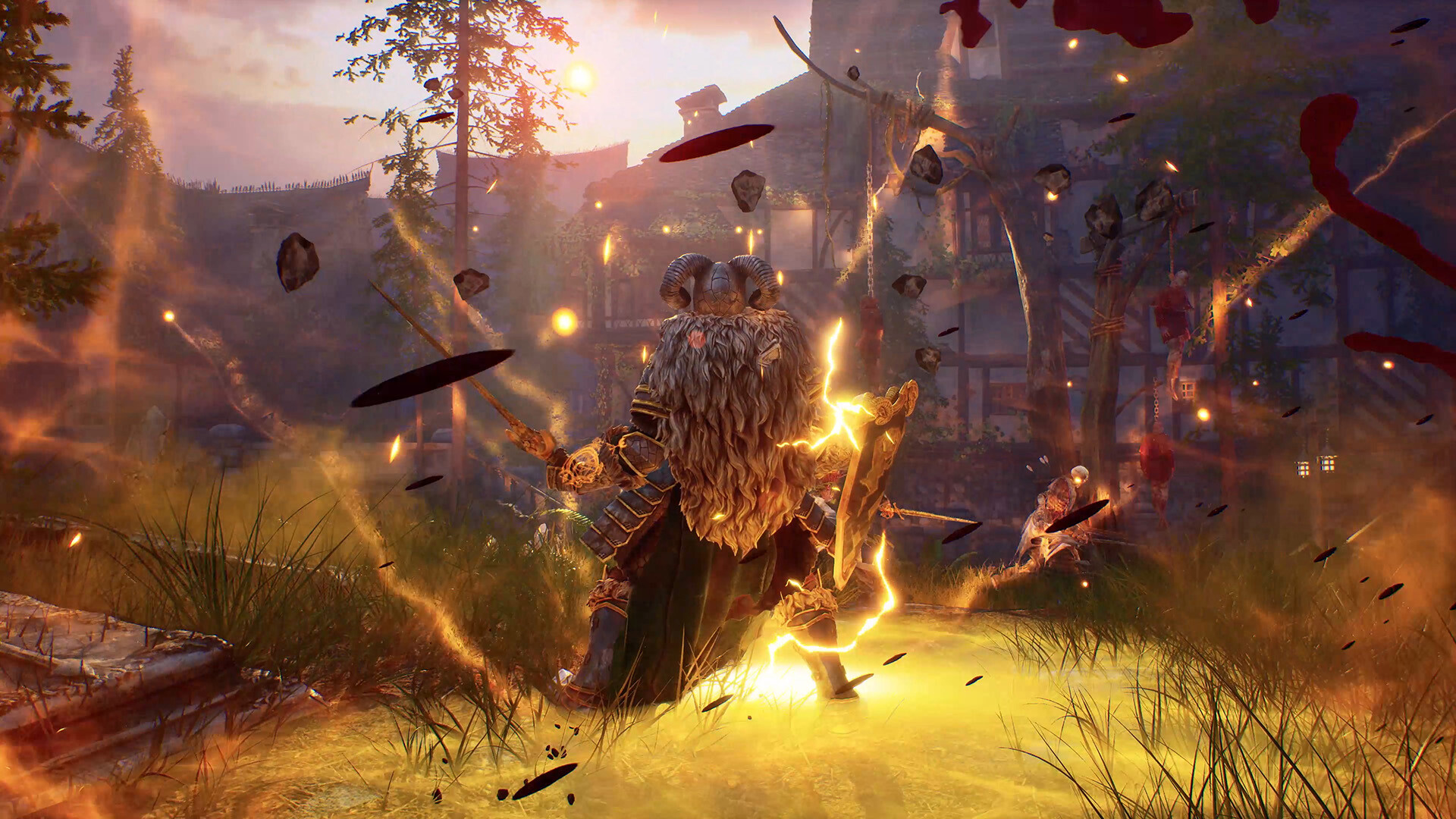
Crimson Moon is built around high-risk, high-reward replayable missions carrying modifiers and skill achievements. GDC 2026 hands-on preview coverage describes individual missions running 15 to 45 minutes, with dynamic layouts and an evolving mission board rather than a fixed, linear level list — closer in shape to a roster of repeatable operations than a single continuous campaign map, and consistent with the Roguelike tag Steam applies to the store listing alongside Souls-like and Hack and Slash.
The February 2026 announcement frames these runs narratively as reclaiming Gildenarch "district by district" from the Infernal Legion, which suggests the evolving mission board tracks territorial progress rather than presenting a purely abstract mission-select menu — full narrative context for that framing is covered on the Story & Setting page.
The 15-to-45-minute range is broad enough to cover both a tight, focused clear and a longer, more thorough run through a given layout, and preview coverage frames that range as a deliberate design choice rather than padding — missions are meant to be replayed, so a shorter run at higher difficulty and a longer, more exploratory run are both treated as valid ways to play the same content.
Dynamic Difficulty Scaling
The official Steam feature list confirms dynamic difficulty scaling: choosing harder settings increases mission rewards. No specific difficulty tiers, numeric multipliers, or named difficulty presets have been published for this page yet — the confirmed mechanic is the reward-for-risk relationship itself, not a particular ladder of settings.
That scaling interacts directly with the dodge/roll/parry/counter combat system and the Celestial Transformation's Angel Power resource covered on the Combat & Powers page: harder settings mean less room for error against the same enemy telegraphs, rather than simply inflating enemy health totals.
"Higher difficulty, higher reward" is a common structure in mission-based action games, and Crimson Moon's own store description ties it directly to the game's "High Risk High Reward" feature bullet — the same phrase used to describe the missions themselves. That framing suggests difficulty and mission modifiers are meant to be read as one connected risk/reward system rather than two separate settings.
Solo Play
Solo play is designed as a complete mode on its own, not a stripped-down version of co-op. GDC 2026 hands-on preview coverage reports the development team framing the solo experience as an intentional, fully realized way to play through Crimson Moon's missions, with the two base loadout options and their gear-driven expansion (see Combat & Powers) working the same way whether or not a second player joins.
PlayStation Store's concept page corroborates full controller support in solo play specifically, listing DualSense vibration and adaptive-trigger support alongside 13 separate accessibility options — detail that points to solo runs being a first-class, fully supported way to experience the game rather than an afterthought next to co-op.
That emphasis matters for a souls-like specifically, since the genre's reputation for punishing difficulty can make players assume co-op is the "easier" or "intended" way to play. Nothing in official copy or preview coverage supports that reading here — the dodge/parry/counter loop, loadout system and Celestial Transformation are all built and balanced with solo play as a first-class mode, not a fallback.
Two-Player Online Co-op
Co-op is entirely optional and capped at two players online. Preview coverage reports that two-player co-op adds mid-battle revival and inter-player synergies on top of the base solo toolkit, rather than simply letting a second player deal extra damage. The PlayStation Store concept page separately confirms an online player cap of two and notes that PS Plus is required for the online mode on PlayStation 5, consistent with Steam's own Online Co-op storefront category.
Full DualShock and DualSense controller support is confirmed for both solo and co-op sessions, and the PlayStation listing's release-date/time entry (September 1, 2026 at 5:00 PM UTC) applies equally to solo and co-op players — there is no separate early-access or staggered rollout confirmed between the two modes.
"Mid-battle revival" specifically implies co-op partners can be knocked down without an instant run-ending failure state, which is a meaningfully different risk profile from solo play, where a knockdown presumably ends the attempt outright. No official material spells out exact revival rules (a timer, a limited number of revives, or a location requirement), so treat this as a confirmed feature without confirmed mechanics yet.
Modifiers, Skill Achievements and Loadouts
Each mission run carries modifiers and skill achievements on top of the core dodge/parry/counter loop, per the official Steam feature description — the combination of a modifier set and the evolving mission board is what keeps individual runs from feeling identical, according to GDC 2026 hands-on coverage of the closed demo. Exact modifier types and how skill achievements pay out have not been itemized publicly yet.
Loadouts start from two base options and expand as you collect armor sets and weapons across runs, covered in more mechanical detail on the Combat & Powers page; the one specific piece of collectible gear confirmed by name so far, the Mahkten Armor Set, is covered on The Church Hub page alongside the Deluxe Edition's cosmetic rewards.
Skill achievements, mission modifiers and the evolving mission board together form the closest thing to a live-service structure Crimson Moon has confirmed so far, without any confirmed season, battle pass or timed-event system — everything currently sits inside the base run structure rather than a separate meta-layer on top of it.